
Without a strategy, marketing becomes guesswork.
A business can spend time creating blog posts, posting on social media platforms, running an ad campaign, investing in search engine optimization, and developing new marketing materials – but activity alone doesn’t guarantee results.
A marketing strategy gives those efforts direction. It connects your marketing activities to specific business objectives and helps you decide where to spend your time, resources, and marketing dollars.
Instead of asking, “What should we market next?” a better question is:
“What are we trying to accomplish, and what marketing efforts will help us get there?”
That’s the foundation of an effective marketing plan.
What Is a Marketing Strategy?
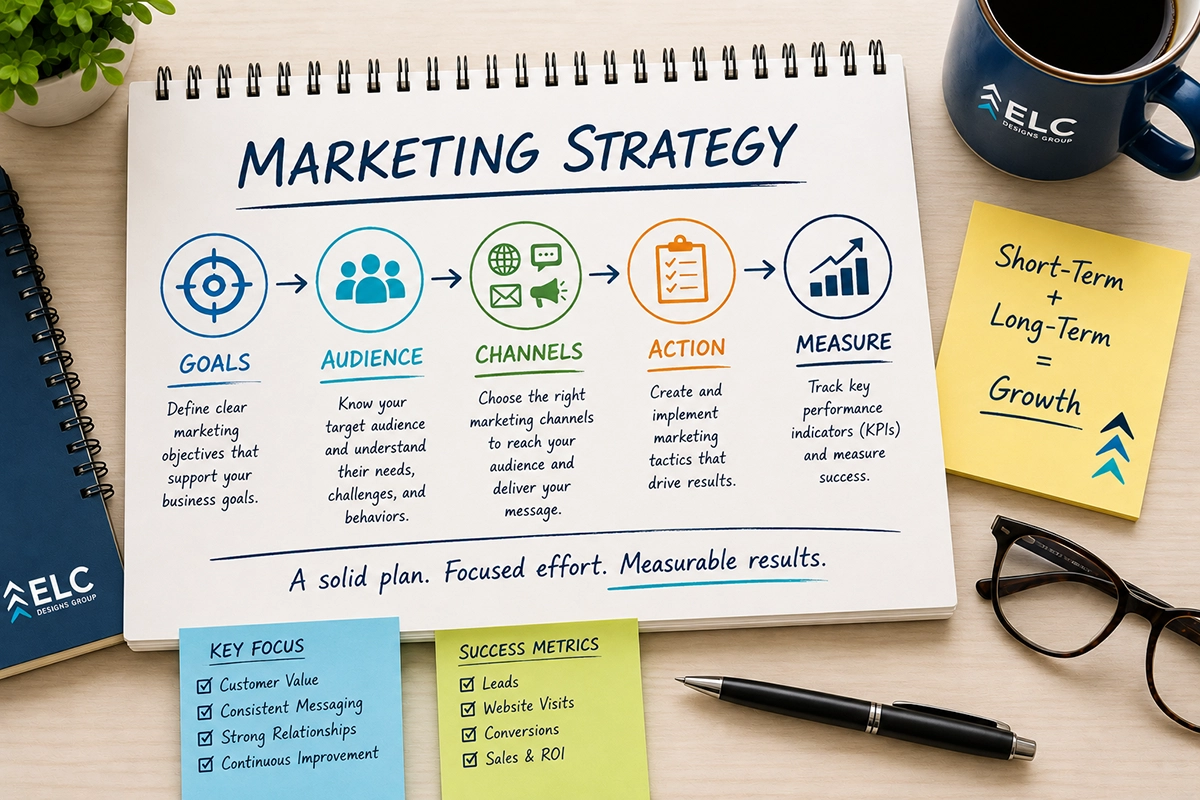
A marketing strategy is the overall approach a business uses to reach prospective customers, communicate its value, convert leads into customers, and build lasting relationships.
Think of it as a strategic blueprint that identifies:
- Your target audience
- Your marketing objectives
- Your unique value proposition
- The marketing channels you’ll use
- The marketing tactics you’ll implement
- How you’ll measure success
Your overarching marketing strategy should support your larger business strategy.
If your company aims to increase sales, expand its customer base, improve market penetration, or generate more leads, your marketing goals should directly support those objectives.
Marketing Strategy vs. Marketing Plan
Although the terms are often used interchangeably, a marketing strategy and marketing plan serve different purposes.
Your strategy establishes the big picture: who you want to reach, what makes your business different, and how marketing will support your business goals.
Your marketing plan identifies how you’ll put that strategy into action through specific campaigns, marketing channels, budgets, timelines, and key performance indicators.
In simple terms:
Strategy determines where you’re going.
Your plan determines how you’ll get there.
An effective marketing plan connects the two.
Start With Your Business Objectives
Before choosing marketing tactics, define what the business needs to accomplish.
Your objectives might include:
- Increasing sales
- Generating qualified leads
- Introducing a new product or service
- Expanding into a new market
- Increasing repeat business
- Improving brand awareness
- Gaining market share
From there, establish specific marketing objectives.
For example, if the business wants more sales for a particular service, the marketing campaign might focus on increasing qualified website visits and lead generation through SEO, paid search, content marketing, and targeted advertising strategies.
Now every activity has a purpose.
Know Your Target Market
A successful strategy starts with understanding the people you’re trying to reach.
Your target market is the broader group most likely to purchase from you. Your target audience may be a more specific group within that market targeted by a particular campaign.
Good market research should help you understand:
- What customers need
- Their pain points
- What they value
- How they research purchases
- Which marketing channels they use
- What influences their decisions
- What prevents them from buying
Businesses can use this information to develop buyer personas representing different types of target customers.
The clearer your picture of the ideal customer, the easier it becomes to create relevant messages and choose the right promotional strategies.
Conduct Market Research and Competitive Analysis
Strong strategic planning is based on information rather than assumptions.
Market research may include:
- Customer surveys and interviews
- Sales data
- Website analytics
- Online reviews
- Social media insights
- Keyword research
- Industry information
- Competitor research
You may discover that what customers value most isn’t what you expected.
You should also examine the competitive landscape. Review competitors’ websites, services, reviews, pricing, social media, search engine results, advertising, and brand messaging.
A SWOT analysis can help organize what you learn by identifying your business’s strengths, weaknesses, opportunities, and threats within the competitive environment.
The purpose isn’t to imitate competitors. It’s to understand where your company fits and identify opportunities to create a genuine competitive advantage.
Define Your Value Proposition
Why should someone choose your business rather than a competitor?
Your unique value proposition, sometimes called a unique selling proposition, should answer that question.
It might be based on:
- Specialized expertise
- Exceptional service
- Convenience
- Faster response
- Better quality
- Local knowledge
- Personal attention
- A unique process
Avoid generic statements such as “quality service at a competitive price.”
A strong value proposition identifies something meaningful to your customers and gives your marketing communications a clear focus. Read our Unique Value Proposition article to learn more.
Understand the Marketing Funnel
Not every prospective customer is ready to buy immediately.
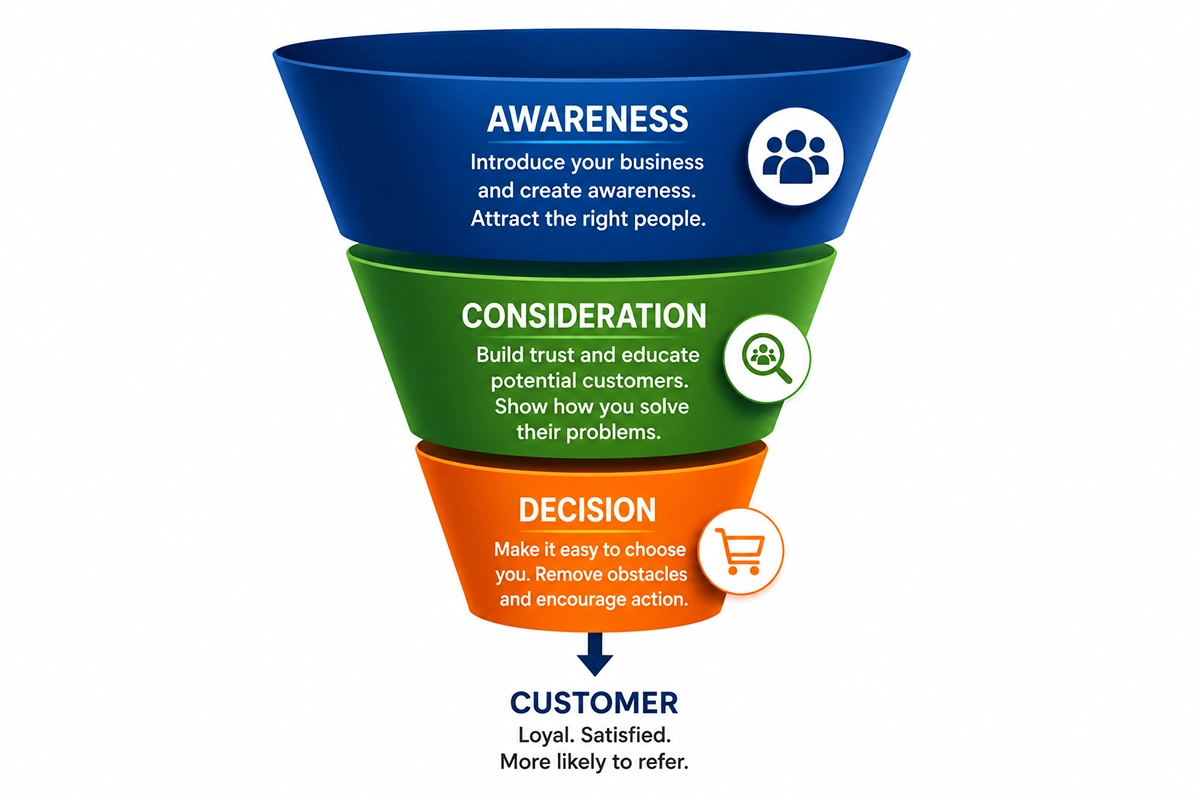
That’s why your marketing funnel should address three basic stages:
Awareness → Consideration → Decision
Awareness
At the top of the funnel, people are discovering your company or becoming aware of a need.
Marketing activities may include:
- Social media
- Search engine optimization
- Blog content
- Public relations
- Video
- Display advertising
The goal is visibility and recognition.
Consideration
Now potential customers are researching solutions and comparing businesses.
Useful content and tactics may include:
- Educational articles
- FAQs
- Case studies
- Customer reviews
- Email marketing
- Detailed website content
- Retargeting
At this stage, customers are deciding whether your company belongs on their shortlist.
Decision
At the bottom of the funnel, the customer is ready to act.
Your marketing should make the next step easy through:
- Clear calls to action
- Quote-request forms
- Online scheduling
- Search advertising
- Promotional offers
- Sales follow-up
Your marketing plan should address the entire funnel rather than focusing only on people ready to buy today.
Don't Forget Current Customers
Marketing shouldn’t end after the first sale.
Current customers can become repeat buyers, referral sources, reviewers, and long-term advocates for your business.
Stay connected through email, educational content, service reminders, loyalty or referral programs, and thoughtful follow-up.
A comprehensive plan considers both customer acquisition and retention.
Choose the Right Marketing Channels
Once you understand your audience and goals, decide where your message should appear.
Potential marketing channels include:
- Your website
- Search engines
- Social media
- Google Business Profile
- Paid digital advertising
- Direct mail
- Radio
- Outdoor advertising
- Events
- Public relations
You don’t need to use every channel.
Choose the ones your target customers actually use and that best support your objectives.
For example, a local service company may rely heavily on Local SEO, Google Business Profile, paid search, reviews, and direct mail. A B2B company may place greater emphasis on LinkedIn, email, networking, and educational content.
Don’t choose channels simply because they’re part of current marketing trends. Choose them because they make sense for your customers.
Include SEO and Content Marketing
For many businesses, digital marketing and organic search should be important parts of the overall strategy.
An SEO marketing plan may include:
- Keyword research
- Website and content optimization
- Local SEO
- Creating blog posts
- Technical improvements
- Link building
- Google Business Profile optimization
These activities help your business become more visible in search engine results when people are looking for relevant products and services.
Content creation supports SEO while also helping customers throughout the marketing funnel.
Blog articles, videos, guides, FAQs, case studies, and social content can answer questions, demonstrate expertise, and help potential customers make decisions.
Every piece of content should have a purpose rather than existing simply because the company feels it needs to post something.
Set a Realistic Marketing Budget
Your marketing budget should reflect your goals and available resources.
It may include:
- Advertising spend
- Website development
- SEO
- Graphic design
- Content creation
- Photography or video
- Printing and mailing
- Marketing software
- Outside marketing support
Thoughtful resource allocation is important.
Spreading a limited budget across too many activities may mean you don’t invest enough in any one of them to generate meaningful results.
Prioritize the channels and tactics most closely connected to your goals, then expand as results and resources grow.
Balance Short-Term and Long-Term Marketing
A strong strategy includes both.
Short-term marketing is designed to create faster action and may include:
- Paid search
- Social media advertising
- Promotions
- Direct mail
- Sales campaigns
These tactics can produce immediate traffic, leads, or sales.
Long-term marketing builds assets, relationships, and awareness over time and may include:
- Search engine optimization
- Content marketing
- Brand development
- Email lists
- Customer relationships
- Online reviews
- Organic social media
Relying only on paid advertising means constantly paying for the next customer. Relying only on long-term marketing may leave the business waiting too long for results.
The strongest overall strategy balances both.
Set Key Performance Indicators (KPIs)
How will you know whether your marketing is working?
That’s where key performance indicators (KPIs) come in.
Useful measurements might include:
- Website visits
- Qualified leads
- Phone calls
- Form submissions
- Appointments
- Conversion rates
- Sales
- Revenue
- Search rankings
- Customer acquisition cost
- Customer retention
- Return on investment
Your key performance indicators should connect directly to your marketing goals.
If the objective is lead generation, social media likes may be interesting, but qualified leads are a much more meaningful measurement.
Measure Marketing ROI
ROI, or return on investment, helps determine whether your marketing investment is producing enough value to justify the cost.
A basic formula is:
(Revenue Attributed to Marketing – Marketing Cost) ÷ Marketing Cost × 100
If an advertising campaign costs $2,000 and generates $8,000 in attributable revenue, that’s a 300% ROI.
However, not every marketing activity should be judged only by immediate sales.
SEO, brand awareness, content marketing, and customer relationship efforts often contribute to results over a longer period. That’s why most businesses should monitor several KPIs instead of relying on one number.
What Should a Marketing Plan Include?
You don’t need a complicated 50-page document.
A practical marketing plan template can include:
- Executive Summary: A brief overview of the plan.
- Mission Statement: What the business does and why.
- Business Objectives: What the company wants to accomplish.
- Target Market: Who your ideal customers are.
- Market Research: What you’ve learned about customers and competitors.
- Value Proposition: Why customers should choose you.
- Marketing Goals: What your marketing needs to accomplish.
- Marketing Channels: Where you’ll reach your audience.
- Marketing Tactics: What you’ll actually do.
- Marketing Budget: How resources will be allocated.
- KPIs: How you’ll measure success.
- Timeline: When activities will occur and when results will be reviewed.
These marketing plan outlines provide enough structure to guide action without making the plan unnecessarily complicated.
A good business plan may establish the company’s overall direction, while the marketing plan provides the structured plan for reaching and retaining customers.
Review, Measure, and Adjust
No marketing strategy should remain unchanged forever.
Customer behavior changes. New competitors appear. Marketing trends evolve. Business priorities shift.
Review your results regularly.
Ask:
- Which channels generate the best leads?
- Which campaigns produce sales?
- Which content attracts website visits?
- Which search terms are improving visibility?
- Where are we wasting money?
- What should we increase, reduce, or test?
An effective strategy isn’t about creating a perfect plan on day one.
It’s about creating a thoughtful plan, implementing it consistently, measuring what happens, and using those insights to make the next decision better.
Strategy Turns Marketing Effort Into Results
Marketing can feel overwhelming when every new platform, advertising opportunity, and trend seems like something your business should be doing.
A strategy gives you permission to say no.
It helps you focus on the customers you want to reach, the goals you need to achieve, and the activities most likely to move your business forward.
Successful marketing isn’t about doing everything.
It’s about doing the right things, for the right audience, for the right reasons—and knowing whether they’re working.
Build a Marketing Strategy with ELC Designs Group
At ELC Designs Group, we help businesses turn disconnected marketing efforts into a clear, actionable strategy.
From market research, brand messaging, and digital marketing to SEO, content creation, social media, marketing materials, and advertising campaigns, we can help you develop a marketing plan built around your customers, your goals, budget, and your best opportunities.
Book a Free Discovery Call to learn more