For years, businesses have worked to improve their SEO rankings so potential customers could find them on Google and other search engines.
Now there’s another place where people search.
Instead of typing a few keywords into Google, someone might open ChatGPT or another AI assistant and ask:
“Who is the best commercial roofer near me?”
“What HVAC company specializes in assisted living facilities?”
“Which local marketing agency do you recommend for medium size businesses?”
“What’s the best CRM for a small sales team?”
AI may respond with several companies, explain the differences, and help the user compare options.
That raises an important question for business owners:
How do I get ChatGPT to recommend my business?
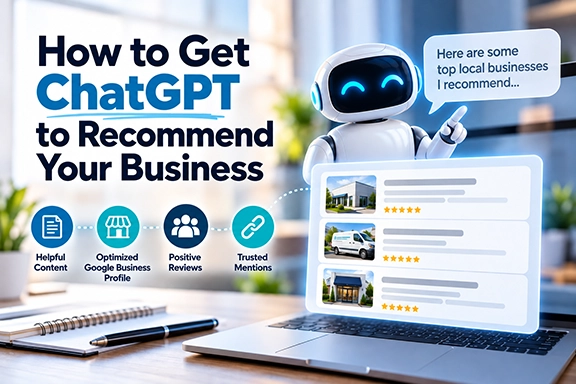
There is no way to guarantee that ChatGPT or another AI tool will recommend your business over another. However, you can improve your chances of appearing in AI-generated answers by building a clear, credible digital presence: publish authoritative content around topics you genuinely know, answer customer questions directly, support important claims with reputable sources, maintain accurate business information, earn legitimate customer reviews and third-party mentions, and make your website easy for search engines and AI systems to understand.
AI authority isn’t created by one page, a keyword, schema setting, or marketing tricks. It’s built over time as search engines, AI platforms, customers, and other websites encounter consistent evidence of who you are and what your business knows.
What Is AI Authority?
AI authority isn’t an official Google, ChatGPT, or SEO score.
It’s a useful way of describing how clearly and credibly your business is represented across the web.
When AI models generate answers, they may draw upon different sources and technologies depending on the platform and query. These can include indexed web content, search results, structured information, third-party sources, and – in some systems – retrieval augmented generation, or RAG.
RAG allows an AI system to retrieve relevant information and use it as context when generating an answer rather than relying exclusively on what existed in its original training data.
That distinction matters.
You can’t simply submit your business to an AI model’s training data. But you can improve the information about your company that is publicly available and accessible on the internet.
In other words, if you want ChatGPT to recommend your company, one useful place to begin is making sure that your web provides clear and consistent evidence about:
Who you are. What you do. Where you operate. What you specialize in. Who you serve. Why customers choose you. And whether reputable sources support those claims.
AI SEO Doesn't Replace Traditional SEO
You’ll hear several names for this emerging area of marketing:
- AI SEO
- AI search optimization
- Answer Engine Optimization (AEO)
- Generative Engine Optimization (GEO)
Although the terminology varies, the basic strategy is similar: make your online information easy for both people and machines to find, understand, and use.
That doesn’t mean traditional SEO is dead.
Far from it.
AI tools still depend heavily on information available across the web, and many AI search engines incorporate traditional search technology into their systems.
A technically healthy website, useful content, crawlable pages, relevant topics, strong local information, reputable links, and good SEO practices still matter.
Think of it this way:
Traditional SEO asks: “Can a search engine find and rank this page?”
AI SEO adds: “Can an AI engine understand this information well enough to use it in an answer?”
You want both.
Start With What You Want Your Business to Be Known For
One of the biggest mistakes companies can make is trying to become an authority on everything.
Instead, choose a specific niche or group of topics where your business has genuine expertise.
An HVAC company might focus on humidity control, indoor air quality, commercial HVAC maintenance, or HVAC systems for senior living facilities.
A commercial roofer might focus on flat roofing, roof coatings, storm damage, inspections, and repair, versus replacement decisions.
A marketing agency might build authority around local marketing, branding, SEO, content marketing, digital advertising, and AI visibility.
These aren’t simply keywords you’re trying to rank for.
They are topics you want associated with your brand.
If someone asks ChatGPT a question about one of those subjects, your goal is to have enough credible information available that your business is relevant to the answer.
Build Topic Depth Instead of Publishing Random Blog Posts
Publishing hundreds of unrelated blog posts doesn’t necessarily create authority.
A better strategy is to develop clusters of genuinely useful content around the subjects you want to own.
Imagine a roofing company wants to become known for commercial roof maintenance.
Instead of writing one general article, it could create a comprehensive commercial roof maintenance guide on their website, supported by smaller web pages & blog articles answering questions such as:
- How often should a commercial roof be inspected?
- What happens during a commercial roof inspection?
- What causes ponding water?
- How long does a flat roof last?
- Can a commercial roof be repaired instead of replaced?
- When should a roof coating be considered?
- What are the warning signs of membrane damage?
Your main page establishes the subject.
The supporting pages explore individual questions in more detail.
Internal links connect them.
Over time, the site develops a clear body of information around that topic.
This can help traditional search engines understand your topical focus while also creating more useful material for AI engines to interpret.
Write the Questions Your Customers Actually Ask
AI search is conversational.
Someone may no longer search:
commercial roof standing water
They may ask an AI assistant:
“Should I be worried about water standing on my commercial roof after it rains?”
That difference should influence your content strategy.
Look at:
- Questions customers ask your sales team
- Customer emails
- Search queries
- Google reviews
- Social media comments
- Customer service conversations
- Questions on review sites
- Questions your employees answer repeatedly
These are clues to what potential customers actually want to know.
If real people keep asking a question, there’s a good chance other people will eventually ask tools like ChatGPT the same thing.
Create content that answers those questions.
Make Your Answers Easy for AI to Understand
If a page asks a question, don’t make readers – or AI machines – dig through 600 words before finding the answer.
Provide a concise response first.
Then explain it.
Use clear headings, short paragraphs, descriptive subheadings, lists where appropriate, definitions, comparisons, tables, examples, and step-by-step instructions.
In other words, structure content so the information is easy to identify.
Suppose your heading is:
How Often Should You Have Your Commercial Roof Inspected?
Answer the question immediately.
Then provide more detail explaining why, when exceptions apply, and what customers should expect.
This makes the page more helpful to human readers and creates clear informational passages that an AI system can more easily interpret.
Build an Evidence Layer Around Important Claims
If you want AI to trust your content, give it more than unsupported marketing statements.
Create an evidence layer.
Suppose your company publishes information about an industry regulation.
Don’t simply state the requirement.
Provide:
- The claim: Clearly explain what the rule or requirement says.
- The context: Explain who it applies to and under what circumstances.
- The source: Link to government agencies, original research, professional organizations, or other reputable sources.
- The date: Identify when time-sensitive information was published, updated, or reviewed.
- The location: Clarify whether the information applies nationally, statewide, or locally.
That helps establish context and creates additional trust signals.
It also reduces ambiguity. An AI system shouldn’t have to guess whether a statement applies to Florida businesses, the entire United States, or the whole world.
Be specific.
High-Quality Content Beats Keyword Stuffing
AI optimization isn’t about cramming the phrase “how to get ChatGPT to recommend your business” into every paragraph.
That’s keyword stuffing, and it creates a poor experience for readers.
Instead, create high-quality content that thoroughly answers the question.
A useful website page might contain:
- A clear definition
- Direct answers
- Expert explanations
- Examples
- Original observations
- Statistics
- Case studies
- Comparisons
- FAQs
- Supporting sources
- Updated information
The objective isn’t to use every possible keyword.
It’s to provide all the information someone reasonably needs to understand the subject.
Good SEO has been moving in this direction for years. AI search makes it even more important.
Use Your Own Experience to Create Information Others Don't Have
One of your greatest advantages is information from your actual business.
Your competitors can rewrite the same generic articles found across the web.
They can’t duplicate your experience.
Consider publishing:
- Original case studies
- Project pages
- Customer success stories
- Before-and-after examples
- Original photos and videos
- Company research
- Surveys
- Local observations
- Expert commentary
- Processes you’ve developed
- Common problems your team encounters
Your product pages and service pages can also answer detailed customer questions rather than simply describing what you sell.
For example, instead of:
“We provide high-quality commercial roofing services.”
Explain the types of roofs you service, the problems you encounter, how inspections work, when repairs are appropriate, what your process involves, and what customers should expect.
You’re demonstrating expertise rather than simply claiming it.
Help AI Understand Your Business
Imagine an AI system trying to piece together your company from dozens of sources.
Your website says one thing.
Your Google Business Profile says another.
Facebook lists different hours.
A directory contains an old phone number.
Your service area isn’t clear.
Your website never clearly explains what makes you different.
That’s a difficult company for AI to understand.
Consistency matters.
Make sure your own website clearly identifies:
- Your company name
- Services or products
- Location and service area
- Contact information
- Areas of specialization
- Experience
- Relevant credentials
- People behind the company
- Who you serve
- What differentiates you
Then reinforce those facts across your broader digital presence.
The clearer the information, the easier it is for search engines, AI assistants, and customers to understand your brand.
Don't Ignore Your Google Business Profile
For a local business, your Google Business Profile remains an important part of your online presence.
Keep your:
- Business name
- Category
- Address or service area
- Phone number
- Website
- Hours
- Services
- Photos
accurate and current.
Your profile also provides something extremely valuable:
Customer reviews.
Google reviews and online reviews provide third-party information about actual customer experiences.
A company can say:
“We provide outstanding customer service.”
But 150 happy customers independently describing responsive communication and excellent service provide something the company’s own marketing copy can’t: social proof.
That distinction matters when you’re trying to build trust online.
Reviews Are Part of Your AI Authority
Don’t think of reviews as something that only affects your star rating.
They add to the public information available about your company.
Reviews can repeatedly associate your business with:
- Specific services
- Products
- Locations
- Employee names
- Customer experiences
- Problems solved
- Areas of expertise
That’s useful context.
Encourage legitimate reviews from real customers and respond professionally.
Also pay attention to other appropriate review platforms in your industry.
You aren’t trying to manufacture signals. You’re helping genuine customer experiences become part of your brand’s public digital footprint.
Use Structured Data and Schema Markup
Structured data provides machines with additional context about the information on a webpage.
Schema markup can help identify things such as an organization, local business, person, article, product, video, event, or breadcrumb structure.
It doesn’t guarantee that ChatGPT – or any of the other AI tools – will recommend your business.
Schema is not a magic AI button.
But it can reduce ambiguity and help machines interpret information on your pages.
Think of structured data as another clarity layer within your overall website strategy.
Your Website Can't Be the Only Place Saying You're Great
Your website is important.
But you control it.
Independent brand mentions can add another dimension to your digital authority.
Depending on the business, these might come from:
- News organizations
- Industry publications
- Professional associations
- Community organizations
- Business directories
- Partners
- Podcasts
- Interviews
- Conferences
- Review platforms
- Other reputable websites
These external references can help establish a broader web presence.
If your website says you’re an expert and independent, credible sources also repeatedly connect your brand with that subject, you have a much stronger collection of signals than you would from your website alone.
Keep Your Brand Visible Across the Web
This doesn’t mean opening accounts on every platform on the internet.
Choose platforms that make sense for your customers and industry.
- Your website might establish expertise.
- Your Google Business Profile establishes local information.
- Reviews provide social proof.
- LinkedIn might demonstrate professional expertise.
- YouTube could provide instructional content.
- Industry publications could establish third-party recognition.
- Social channels can reinforce your brand and distribute your expertise.
Together, these create a broader digital presence and help keep your brand visible where people – and potentially AI systems – look for information.
Can You Get ChatGPT to Recommend Your Business?
There is no guaranteed formula to get ChatGPT to recommend a particular company.
The same applies to other AI platforms.
AI responses can vary based on the question, available sources, system, location context, freshness of information, and other factors.
That’s why promises such as:
“We’ll get ChatGPT to recommend your business in 30 days!”
should be treated cautiously.
No reputable company can promise endless customers simply by optimizing a few webpages for AI.
AI visibility is a long game.
Your objective is to continually improve the quantity, quality, clarity, consistency, and credibility of the information available about your company.
Measure Your AI Visibility
Traditional SEO gave businesses familiar measurements such as rankings, impressions, clicks, traffic, and conversions.
AI requires some additional questions:
- Is our company mentioned in AI responses?
- Which competitors are mentioned?
- What sources are cited?
- Which topics trigger brand mentions?
- Is the information about our company accurate?
- Which pages on our website are being cited?
Create a baseline around the questions most important to your business and check them periodically across relevant AI platforms.
Don’t panic if your business isn’t mentioned every time.
AI responses can change.
Instead, look for patterns and opportunities.
If competitors consistently appear and your company doesn’t, examine why. Do they have stronger topic coverage? More detailed service pages? Better reviews? More third-party mentions? More authoritative links? Clearer business information?
Those findings can help shape your strategy.

AI Authority Is Built From Multiple Trust Signals
There probably isn’t one factor that carries significant weight in every AI system and every search.
Different AI models and search systems work differently.
Rather than searching for one secret ranking factor, strengthen the entire ecosystem around your brand:
Helpful website content + clear business information + structured data + topical expertise + customer reviews + reputable third-party mentions + consistent business information + traditional SEO + current information.
No individual element guarantees AI visibility.
Together, however, they create a much clearer and more credible digital identity.
AI Authority Is a Long Game
Businesses spent years learning how to appear in traditional search.
AI search is still evolving.
The companies most likely to build durable visibility won’t be the ones chasing every new trick or trying to manipulate AI engines.
They’ll be the companies doing the foundational work:
- Creating genuinely useful content.
- Answering real customer questions.
- Demonstrating first-hand expertise.
- Building topic depth.
- Supporting factual claims with reputable sources.
- Keeping information accurate.
- Collecting legitimate customer reviews.
- Earning third-party recognition.
- Using SEO and structured data correctly.
- And maintaining a strong, consistent presence across the web.
That’s not a shortcut.
It’s a strategy.
From Search Visibility to AI Authority
For years, digital marketing focused heavily on one question:
Can people find your business in search?
Now we need to add another:
When people ask AI for answers, does the web provide enough clear, credible information for your business to become part of the conversation?
If you find yourself asking, “How do I get ChatGPT to recommend my business?”, don’t begin by trying to manipulate ChatGPT.
Begin with your business.
Determine what you genuinely know.
Choose the topics you deserve to be associated with.
Create the most useful resources you can.
Build evidence around your claims.
Make your expertise visible beyond your own website.
And give both customers and machines clear reasons to trust what they find.
Over time, you’re doing more than improving AI visibility.
You’re building authority.
Build Your AI Authority with ELC Designs Group
At ELC Designs Group, we help businesses strengthen their digital presence for both today’s search engines and the emerging world of AI search.
From SEO, website strategy, content development, local marketing, and brand messaging to structured content and AI authority strategies, we can help make your company easier for customers, search engines, and AI tools to find and understand.
The goal isn’t simply to recommend your business to an algorithm.
It’s to build a business presence that’s credible enough that customers – and the tools they use to search – have a reason to pay attention.
Because the future of visibility isn’t just being found. It’s becoming a trusted source.
Book a Free Discovery Call to learn more