
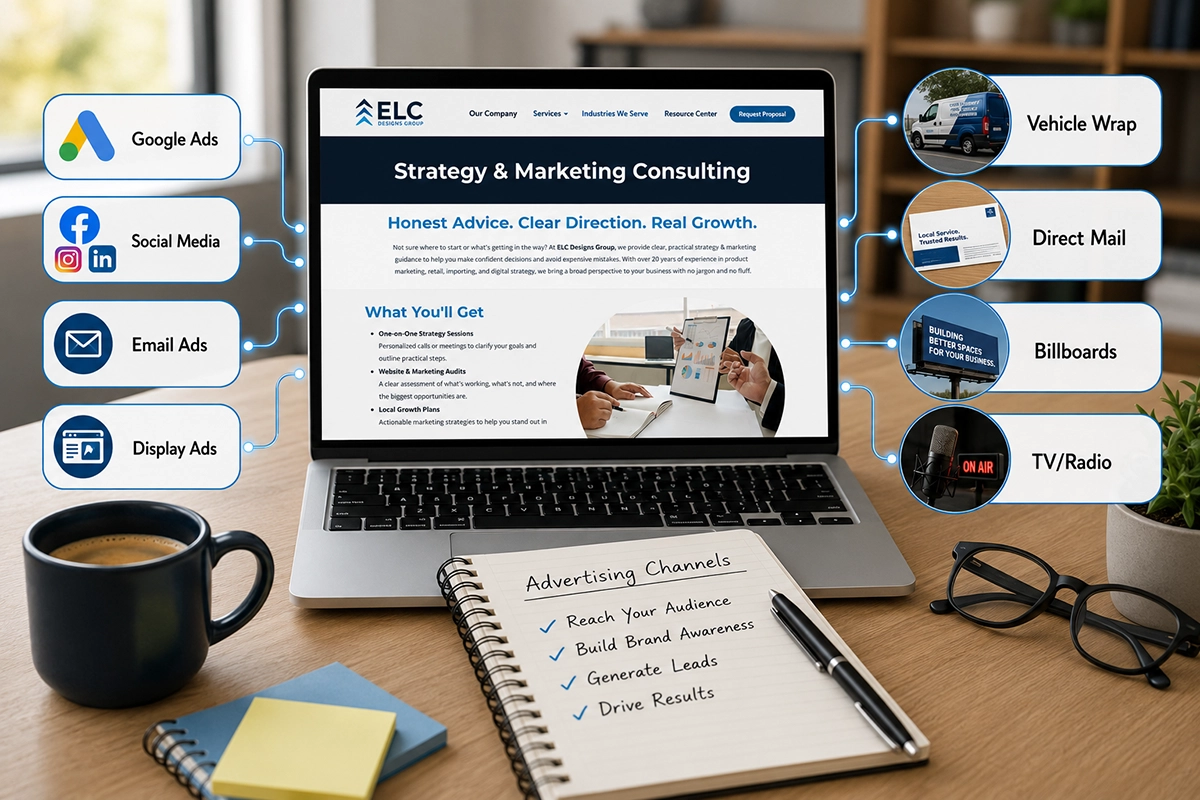
Advertising is how you actively place your business in front of potential customers.
Unlike organic marketing efforts that help people discover your company over time, advertising allows you to pay for immediate visibility through selected media channels. This may mean placing an ad alongside organic search results, promoting a post on social media, sending direct mail, running a radio commercial, or installing an outdoor billboard.
The number of available advertising channels can feel overwhelming, especially for small businesses with limited budgets. The solution is not to advertise everywhere. It’s to identify your target audience, understand your business goals, and choose the channels most likely to reach the right people.
Learning a few advertising basics can help you spend more wisely, improve advertising effectiveness, and build campaigns that generate measurable results.
Advertising vs. Marketing
Advertising and marketing are closely related, but they are not the same thing.
Marketing is the broader process of understanding a market, defining a target audience, creating an offer, establishing a brand, choosing distribution channels, and communicating with customers.
Advertising is one part of that process.
For example, a company’s marketing strategy may include:
- Market research
- Brand development
- Website content
- Public relations
- Search engine optimization
- Email marketing
- Social media
- Customer retention
- Paid advertising
Advertising supports your strategy by purchasing exposure through selected channels.
Without a clear marketing plan, advertising can become a series of disconnected promotions. With a defined strategy, each ad campaign supports larger business objectives.
The Main Types of Advertising
The modern advertising landscape includes both digital and traditional channels.
Neither category is automatically better. The best choice depends on your target market, budget, goals, location, and buying behavior of potential consumers.
Digital Advertising
Digital advertising includes paid promotions delivered through online platforms, websites, apps, search engines, and social media platforms.
Common forms include:
- Search ads
- Social media ads
- Display advertising
- Video advertising
- Mobile advertising
- Native advertising
- Programmatic advertising
- Sponsored content
- Email advertising
- Banner ads
Digital ads allow you to target specific audiences and measure results in greater detail than most traditional advertising methods.
Search Advertising
Search advertising, such as Google ads, places paid text ads in search engine results when people look for particular products or services.
These ads commonly appear above or alongside organic search results.
Most search advertising uses a pay-per-click model, meaning the company pays when someone clicks the ad.
Search ads are often effective because they reach people who are already showing intent.
For example, someone searching for “emergency plumber near me” may be much closer to making a purchase than someone casually browsing a social media feed.
Search advertising can support:
- Lead generation
- Online sales
- Appointment requests
- Local store visits
- Phone calls
- Website traffic
The strength of search advertising is relevance. The ad appears when a potential customer is actively searching for something related to the product or service.
Social Media Advertising
Social media advertising allows businesses to promote content on platforms such as Facebook, Instagram, LinkedIn, TikTok, Pinterest, and other social networks.
These platforms use demographic data, interests, online behavior, and engagement patterns to help advertisers reach specific groups.
Businesses may target people based on:
- Age
- Location
- Interests
- Occupation
- Life events
- Previous website visits
- Online shopping behavior
- Engagement with existing content
Social media ads can be especially useful for building brand awareness, promoting visual products, introducing a new service, or reaching a clearly defined target audience.
They may also support user-generated content by promoting customer testimonials, reviews, photographs, or videos.
Display Advertising
Display advertising uses visual online ads that appear across websites, apps, and digital networks.
Display ads may include:
- Banner ads
- Graphic advertisements
- Animated ads
- Interactive advertising
- Video placements
- Retargeting ads
These ads are often used to raise awareness or remind previous visitors about a company.
For example, someone may visit a retailer’s website and later see display ads for the same products on other online platforms.
Display advertising can provide wide visibility, but careful targeting is essential. Poorly targeted display ads may receive many impressions without producing meaningful action.
Video Advertising
Video advertising includes paid video content shown on social media, streaming platforms, websites, and video-sharing services.
A video ad may be:
- A short social media clip
- A pre-roll ad shown before online content
- A sponsored demonstration
- A customer testimonial
- A digital television commercial
- An interactive product video
- Video advertising can create a strong emotional connection because it combines visuals, movement, sound, and storytelling.
It is often effective for demonstrating a product, explaining a service, or building familiarity with a brand.
Mobile Advertising
Mobile advertising is designed for smartphones and tablets.
It may include:
- Mobile search ads
- In-app advertisements
- Social media ads
- Mobile display ads
- Text message promotions
- Location-based ads
Because many consumers use mobile devices throughout the purchasing process, mobile advertising is now an important part of most digital advertising strategies.
Ads should be designed for small screens, load quickly, and lead to mobile-friendly landing pages.
Native Advertising
Native advertising is designed to match the appearance and style of the platform where it appears.
Examples include sponsored articles, promoted recommendations, and paid social media posts that resemble regular content.
Native ads can feel less disruptive than traditional banner ads, but they should still be clearly identified as sponsored content.
Effective native advertising provides useful or interesting information rather than relying only on direct sales language.
Traditional Advertising
Traditional advertising includes paid media that exists outside most internet-based channels.
Common examples include:
- Print advertising
- Direct mail
- Radio advertising
- Television advertising
- Outdoor advertising
- Event sponsorships
- Newspaper ads
- Magazine ads
Traditional advertising often reaches a broad audience and can create strong local or regional visibility.
Print Advertising
Print advertising includes newspaper ads, magazine ads, brochures, flyers, directories, and other printed materials.
Print can be useful when the audience regularly reads a particular publication or when a business serves a defined geographic area.
For example, local businesses may place ads in:
- Community newspapers
- Regional magazines
- Homeowner association publications
- Industry journals
- Event programs
- Chamber of commerce directories
Print ads should include a clear message, strong visual hierarchy, contact information, and an easy next step.
Direct Mail
Direct mail includes postcards, letters, catalogs, coupons, and promotional packages sent to homes or businesses.
It can be targeted using location, household characteristics, property data, customer lists, or purchasing history.
Direct mail is often effective for:
- Local service businesses
- Retail promotions
- New store openings
- Seasonal campaigns
- Customer reactivation
- Neighborhood targeting
A successful direct mail campaign requires more than an attractive design. It also depends on list quality, timing, repetition, the offer, and a clear call to action.
Radio Advertising
Radio advertising allows businesses to reach listeners through local, regional, satellite, or streaming stations.
Radio ads can build familiarity through repeated exposure and work especially well when the audience regularly listens during commuting or work hours.
A radio advertisement should:
- Capture attention quickly
- Focus on one main idea
- Repeat the business name
- Include a clear benefit
- End with an easy next step
Because listeners cannot see the information, phone numbers and web addresses should be simple and easy to remember.
Television Advertising
Television advertising combines visual storytelling with broad reach.
A television commercial may appear on local broadcast stations, cable networks, streaming television services, or connected devices.
Traditional television advertising can provide high visibility, while streaming platforms may offer more precise targeting.
Television can be valuable for building brand awareness, but production and placement costs may be higher than many other advertising channels.
The message should remain simple because viewers may only see the commercial briefly.
Outdoor Advertising
Outdoor advertising includes:
- Billboards
- Transit ads
- Bus shelters
- Building signs
- Digital displays
- Vehicle wraps
- Posters
- Street furniture
Outdoor ads are designed for quick recognition.
Drivers and pedestrians may only have a few seconds to view the message, so effective outdoor advertising generally includes:
- A short headline
- One strong visual
- A recognizable logo
- High-contrast design
- Minimal text
- A simple call to action
Outdoor advertising can be effective for local businesses, events, retail locations, and companies seeking broad market visibility.
Digital Advertising vs. Traditional Advertising
Digital and traditional advertising each offer distinct advantages.
Digital Advertising Is Targeted and Measurable
Digital advertising typically allows businesses to:
- Target specific audiences
- Adjust campaigns quickly
- Track clicks and conversions
- Test multiple messages
- Control daily spending
- Retarget previous website visitors
- Measure cost per lead
It can be especially useful when the business wants immediate data or serves a narrow audience.
Traditional Advertising Offers Broad Visibility
Traditional advertising can help businesses:
- Reach a large local audience
- Build community familiarity
- Create repeated offline exposure
- Reach people who are less active online
- Reinforce legitimacy
- Maintain visibility throughout a market
Traditional channels may be particularly valuable for location-based companies or products intended for a mass market.
The Strongest Campaigns May Use Both
Many businesses benefit from combining digital and traditional advertising.
A home-service company might use:
- Billboards for broad brand recognition
- Direct mail for neighborhood targeting
- Search ads for active buyers
- Social media ads for retargeting
- Radio for repeated local exposure
These channels support one another by reaching the target audience in different settings.
This does not mean every business needs to advertise everywhere. It means the advertising strategy should reflect how customers move between offline and online media.
How to Choose the Right Advertising Channels
Choosing the right channels begins with three factors: audience, budget, and goals.
1. Understand Your Target Audience
Before choosing a media channel, identify the people the campaign should reach.
Ask:
- Where do they live?
- How old are they?
- Which social media platforms do they use?
- What publications do they read?
- Do they listen to local radio?
- How do they search for services?
- Do they shop online?
- What influences their purchase decisions?
- Which problems are they trying to solve?
Market research and customer data can help answer these questions.
Businesses may also create personas representing their ideal customers. These personas help advertisers select channels and develop messages that feel more specific.
A channel should be chosen because the target audience uses it—not simply because it is popular.
2. Define Your Business Goals
Every advertising campaign should support a measurable objective.
Possible goals include:
- Increasing website traffic
- Generating leads
- Selling a product
- Promoting an event
- Raising awareness
- Entering a new market
- Retaining customers
- Increasing store visits
- Launching a new service
- Improving brand recognition
A campaign designed for immediate sales may require different channels than one designed to build long-term awareness.
For example, search ads may be effective for generating leads from people already looking for a service. Outdoor ads may be better for building broad recognition within a local market.
3. Set a Realistic Budget
Advertising spend should reflect the company’s financial resources and business objectives.
A realistic budget includes more than the cost of ad placement.
It may also include:
- Graphic design
- Copywriting
- Photography
- Video production
- Landing page development
- Printing
- Mailing
- Campaign management
- Tracking systems
A small budget can still work when the campaign is focused.
Spreading a limited budget across too many advertising channels often produces weak results because no single channel receives enough repetition or data to perform effectively.
It is usually better to test one or two carefully selected channels than to make a minimal investment in six.
4. Match the Channel to the Buying Process
Different channels support different stages of the customer journey.
Awareness Stage
The audience may not yet know the business or recognize a need.
Useful channels may include:
- Outdoor advertising
- Social media advertising
- Video advertising
- Radio
- Television
- Display advertising
- Public relations
Consideration Stage
The customer is researching options.
Useful channels may include:
- Search advertising
- Retargeting ads
- Educational video
- Native advertising
- Sponsored content
- Email campaigns
Decision Stage
The customer is ready to take action.
Useful channels may include:
- Search ads
- Direct-response social ads
- Special-offer emails
- Direct mail
- Retargeting
- Local digital advertising
A strong campaign may use different channels at different stages.
5. Consider Geography
A business serving one city should not pay to reach an entire country.
Geographic targeting helps control ad spend and improve relevance.
Local businesses may target by:
- ZIP code
- City
- County
- Radius
- Neighborhood
- Driving distance
- Service area
National companies may use broader targeting, but they may still divide campaigns by region, climate, customer behavior, or market conditions.
The geographic scope should match the area the business can realistically serve.
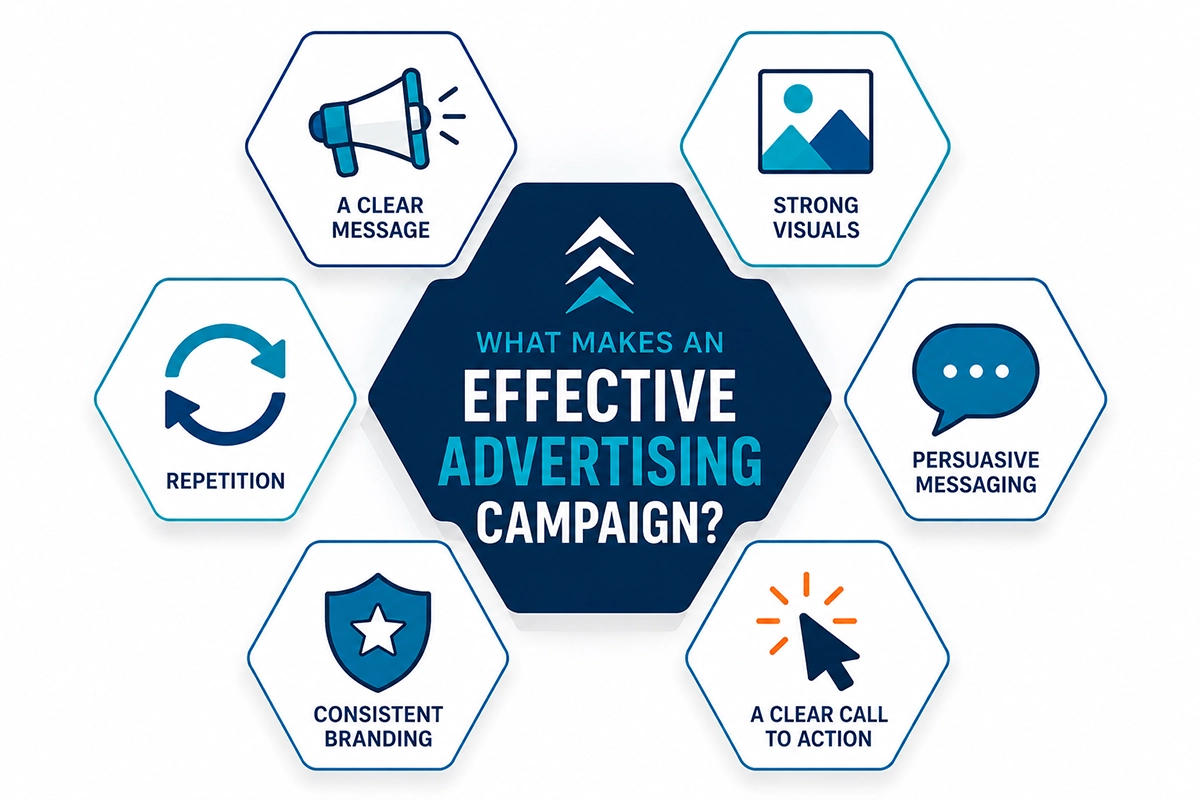
What Makes an Effective Advertising Campaign?
An effective advertising campaign does more than attract attention. It communicates the right message to the right audience and encourages a clear action.
A Clear Message
The audience should understand the main idea quickly.
Avoid trying to communicate every feature, benefit, service, and company achievement in one advertisement.
Focus on:
- One audience
- One problem
- One key benefit
- One offer
- One next step
Clarity is more persuasive than complexity.
Strong Visuals
Good design helps an ad stand out and makes the message easier to understand.
Visuals should support the offer rather than compete with it.
Effective ads typically use:
- Clear hierarchy
- Readable fonts
- Consistent brand colors
- Relevant imagery
- Adequate white space
- A recognizable logo
- Strong contrast
An attractive ad is valuable, but the design must also serve the advertising objective.
Persuasive Messaging
Effective advertising connects the product or service to something the customer values.
A beverage company may advertise refreshment, convenience, flavor, or social connection rather than simply listing ingredients.
Soap manufacturers may focus on cleanliness, skin care, fragrance, sustainability, or family protection.
The strongest message depends on the audience’s needs and motivations.
Persuasive messaging may appeal to:
- Convenience
- Savings
- Safety
- Comfort
- Status
- Reliability
- Urgency
- Belonging
- Confidence
- Emotional connection
The message should remain honest and supported by what the business can deliver.
A Clear Call to Action
The call to action tells the audience what to do next.
Examples include:
- Call today
- Request a quote
- Visit our website
- Shop now
- Schedule an appointment
- Download the guide
- Visit our store
- Learn more
- Sign up
- Use the offer code
The next step should be easy to understand and complete.
Consistent Branding
The advertisement should look and sound like the company.
Use consistent:
- Logos
- Colors
- Fonts
- Tone
- Messaging
- Offers
- Contact details
Consistency helps customers recognize specific brands across different media channels.
Repetition
Most consumers do not act after seeing one advertisement.
Successful advertising often requires repeated exposure.
Repetition helps:
- Build familiarity
- Increase recall
- Reinforce the message
- Establish credibility
- Reach people at the right time
One isolated ad may fail even when the channel and message are strong.
The campaign should run long enough to produce meaningful data.
Why Advertising Campaigns Fail
Advertising can fail for several reasons, including poor strategy, weak execution, or unrealistic expectations, or lack of consistency.
Poor Targeting
An ad can be well designed and still fail if it reaches the wrong people.
Poor targeting wastes money on consumers who:
- Do not need the service
- Live outside the service area
- Cannot afford the product
- Are not involved in the buying decision
- Use a different media channel
- Are unlikely to respond to the offer
Strong targeting begins with research, not assumptions.
Weak Messaging
A vague message gives the audience little reason to pay attention.
Examples of weak messaging include:
- “We offer quality service.”
- “Your trusted local company.”
- “Contact us for more information.”
These statements may be true, but they are not specific.
A stronger message explains the problem, benefit, offer, or reason to act.
No Clear Offer
The audience should understand what is being promoted.
An offer might include:
- A consultation
- A limited-time price
- A free estimate
- A new product
- A special package
- An event
- A downloadable resource
- A specific service
When an ad contains no clear offer, potential customers may not know why they should respond.
Lack of Consistency
Advertising that changes constantly may never build enough recognition to become effective.
Repeatedly changing the logo, colors, message, offer, or audience makes it harder to determine what is working.
Campaigns need consistency before meaningful conclusions can be drawn.
Sending People to the Wrong Destination
A digital ad should direct users to a page that matches the message.
For example, an ad promoting air-conditioning repair should not lead to a general homepage where visitors must search for the service.
The landing page should include:
- The same offer
- Similar visuals and wording
- Supporting information
- Trust signals
- A clear call to action
- Easy contact options
The advertisement and destination should feel like one connected experience.
Failing to Track Results
Without tracking, a business cannot accurately measure advertising effectiveness.
Depending on the media channel, tracking methods may include:
- Website analytics
- Conversion tracking
- Unique phone numbers
- QR codes
- Offer codes
- Landing pages
- Form submissions
- Point-of-sale questions
- Customer surveys
- Call tracking
The goal is to understand which advertisements produce traffic, leads, sales, or awareness.
How to Measure Advertising Effectiveness
he right metrics depend on the campaign goal.
Possible measurements include:
Awareness Metrics
- Ad impressions
- Reach
- Video views
- Website visits
- Search volume
- Social engagement
- Brand recall
Lead Generation Metrics
- Phone calls
- Form submissions
- Quote requests
- Appointments
- Downloads
- Email signups
- Sales Metrics
- Purchases
- Revenue
- Conversion rate
- Average order value
- Return on ad spend
Efficiency Metrics
- Cost per click
- Cost per lead
- Cost per acquisition
- Click-through rate
- Ad frequency
A campaign should not be judged by one number alone.
For example, an outdoor campaign may not generate trackable clicks but may increase branded search activity and recognition. A search campaign may produce fewer impressions but more immediate leads.
Advertising effectiveness should be evaluated according to the original business goals.
Test, Measure, and Refine
Successful advertising is a process.
The first campaign may not produce the best possible result. Businesses improve performance by testing different elements and learning from the data.
Possible tests include:
- Headlines
- Images
- Calls to action
- Offers
- Audience segments
- Geographic areas
- Landing pages
- Ad formats
- Campaign timing
- Testing should be structured.
Changing every element at once makes it difficult to know what caused the result.
Start with a clear strategy, gather enough data, identify patterns, and refine the next ad campaign based on what you learn.
Build a Balanced Advertising Strategy
The best advertising channel is not necessarily the newest, cheapest, or most popular.
It is the channel that reaches your target audience, supports your goals, fits your budget, and provides a realistic way to measure success.
For some small businesses, that may mean combining Google search ads with direct mail.
For others, it may mean social media advertising, local radio, and outdoor signage.
A strong advertising strategy considers how different channels work together rather than evaluating each one in isolation.
Choose Advertising Channels with Confidence
At ELC Designs Group, we help businesses develop advertising strategies based on their audience, goals, budget, and market.
From digital advertising and social media campaigns to direct mail, print advertising, billboards, website landing pages, and campaign design, we create cohesive advertising materials that help businesses reach potential customers and communicate more effectively.
Test, measure, and refine. Successful advertising is not a single event—it is an ongoing process of learning what reaches your customers and motivates them to act.
Book a Free Discovery Call to learn more