
Customers rarely buy the first time they encounter a business.
They may see a social media post, notice a sign, visit a website, hear an advertisement, or receive an email without taking immediate action. That does not necessarily mean your marketing failed. It may simply mean the customer was not ready to buy yet.
There’s actually a saying in marketing & advertising that goes, “On any given day only 2% of the population is ready to buy a given product or service. The other 98% are forming opinions”.
The real question is will that 98% remember your business when the moment arrives?
This is where consistency and top-of-mind-awareness (sometimes called TOMA) become so important.
Top-of-mind-awareness is the reason a customer thinks of one company before all the others when they need a particular product or service. It’s created through repetition, consistent messaging, recognizable branding, and meaningful connections built over time.
Businesses that remain visible are more likely to earn trust, attract new audiences, retain loyal customers, and drive business growth. Businesses that disappear from view often disappear from customers’ minds as well.
What Is Top-of-Mind Awareness?
Top-of-mind awareness means your business is the first brand a customer thinks of within a particular category.
For example, if someone were asked: “Which local roofing company comes to mind first? The company named first has achieved top-of-mind awareness with that consumer.
The same principle applies to nearly every product category and service category, including:
- Restaurants
- Marketing agencies
- Plumbers
- Insurance companies
- Retail stores
- Auto repair shops
- Home builders
- Medical providers
- Beverage companies
- Professional services
A customer may know several companies within a particular industry, but only one may achieve instant recall. That position is valuable because customers often begin their purchase decisions with the companies already familiar to them.
Let’s play a quick game…
What’s the first brand that pops into your head when you think of:
- Toothpaste?
- Laundry detergent?
- Soft drinks?
Don’t overthink it – just go with the first name that came to mind.
If you’re like most people, you probably thought of Colgate or Crest for toothpaste, Tide for laundry detergent, and Coke for soft drinks. In fact, about 94% of people asked to name a soft drink brand say Coke first.
That’s the power of top-of-mind awareness – and it’s exactly what every business should be striving for.
Brand Awareness vs. Top-of-Mind Awareness
Brand awareness describes whether consumers recognize or remember a given brand.
Top-of-mind awareness goes one step further. It means the business is not simply recognized – it’s remembered first.
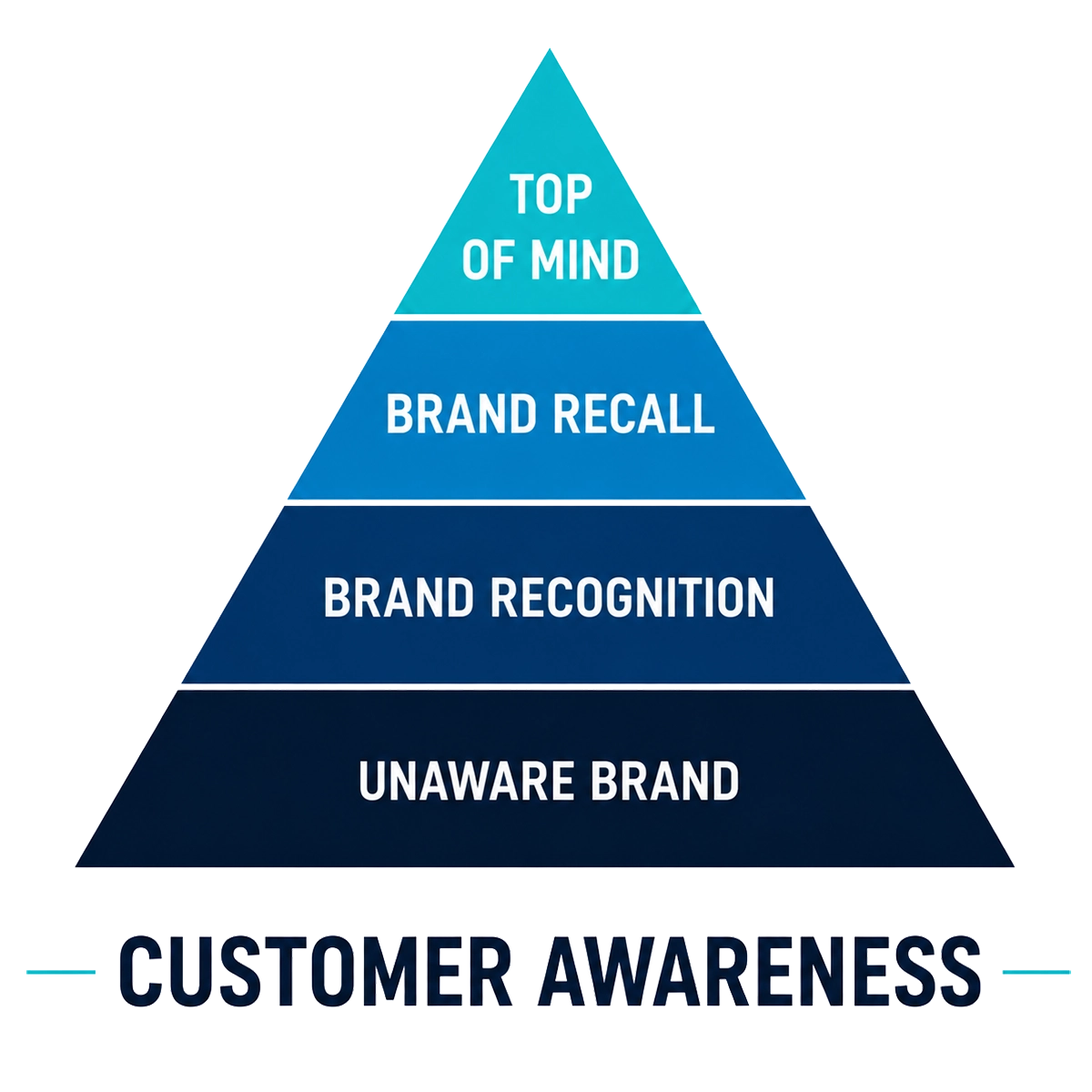
There are several levels of awareness:
- Brand recognition: A consumer recognizes the name, logo, colors, or visual identity.
- Brand recall: A consumer can remember the brand without seeing it.
- Top-of-mind awareness: The brand is the first one that comes to mind within a general product category.
- Brand preference: The customer is more likely to choose that specific brand over alternatives.
- Brand loyalty: The customer repeatedly chooses the company and may recommend it to others.
The ultimate goal is not simply to make consumers aware that a business exists. It is to create enough familiarity, trust, and emotional connection that the company becomes the natural first choice.
Why Top-of-Mind Awareness Matters
Did you know that 71% of consumers prefer familiar brands before purchasing? When customers need a service, they do not always conduct an exhaustive search of the entire market.
They often begin with the brands they already know.
A customer may think:
- “I have seen that company’s signs.”
- “They post helpful information online.”
- “A friend recommended them.”
- “I remember their logo.”
- “They always seem active in the community.”
- “I’ve heard their name several times.”
Those repeated impressions create familiarity.
Familiarity helps build trust, and trust influences sales.
Strong top-of-mind awareness can help a business:
- Attract more qualified prospects
- Increase brand awareness
- Strengthen brand recall
- Build customer loyalty
- Generate more referrals
- Improve marketing performance
- Reach new audiences
- Gain market share
- Shorten the buying process
- Drive business growth
When a customer thinks of your business first, you have a significant advantage before the comparison process even begins.
The Power of Repetition
People need to encounter a brand multiple times before they remember it or feel ready to act.
One social media post, one advertisement, one email, or one direct-mail piece is unlikely to create lasting awareness by itself.
Repetition helps move a business from unfamiliar to recognizable.
A potential customer may:
See a social media post.
Notice the company logo on a vehicle.
Find a blog article through a search engine.
Receive a postcard.
Hear the company mentioned by a friend.
Visit the website.
See another advertisement.
Finally make contact when the need arises.
No single exposure may deserve all the credit. The combined effect of multiple marketing efforts creates the lasting impression.
That is why consistency is usually more important than short periods of intense advertising.
Consistency Is More Important Than Intensity
Many businesses market aggressively for a few weeks and then stop.
They may launch several ads, publish daily social media content, send promotional emails, and invest heavily in a campaign. When sales do not increase immediately, they assume the strategy did not work.
Then the marketing disappears.
This creates a cycle of activity followed by silence.
A steadier approach is often more effective.
Publishing two useful social media posts every week for a year can create stronger brand presence than posting twice a day for one month and then abandoning the platform.
Sending one valuable email each month can be more effective than sending several emails during a promotion and nothing for the rest of the year.
Consistent marketing teaches consumers that the business is active, dependable, and established.
What Consistent Marketing Looks Like
Consistency does not mean repeating the exact same advertisement forever.
It means presenting a recognizable and unified brand across multiple channels.
Consistent marketing includes:
- Using the same logo and brand colors
- Maintaining a recognizable brand voice
- Repeating key messages
- Publishing on a dependable schedule
- Reinforcing the same values
- Promoting a clear area of expertise
- Providing a consistent customer experience
- Staying visible throughout the year
Customers should be able to encounter your business on different platforms and immediately recognize that each message comes from the same company.
Why Consistent Messaging Matters
A business becomes harder to remember when its message changes constantly.
For instance, a company may promote itself as the most affordable option one month, the highest-quality option the next, and the fastest provider after that.
Each claim may be valid, but together they can create confusion.
Consistent messaging gives customers a clear understanding of:
- What the company does
- Who it serves
- What makes it different
- What values it represents
- Why customers should choose it
A strong message should be flexible enough to support different campaigns while remaining tied to the same central brand promise.
The goal is not to sound repetitive. The goal is to become recognizable.
Create a Brand Style Guide
A brand style guide helps ensure that everyone representing your business uses the same visual and verbal standards.
It may include:
- Logo versions
- Approved colors
- Fonts/Typography
- Image styles
- Brand voice
- Taglines
- Key messages
- Writing standards
- Social media guidelines
- Examples of correct and incorrect usage
This guide is especially valuable when multiple employees, vendors, designers, or business partners create content.
Without clear standards, different marketing materials may look as though they belong to different companies.
A brand style guide protects consistency and makes the brand easier to recognize.
Use Multiple Channels
Top-of-mind awareness is rarely built through one media channel alone.
Customers spend time across multiple channels, including:
- Search engines
- Social media
- Websites
- Local publications
- Direct mail
- Outdoor advertising
- Community events
- Radio
- Video platforms
- Referral networks
A business becomes more memorable when customers encounter the same brand message in several places.
Example: a customer may first discover a company through social media, later see it in local search results, receive a direct mail piece, and then recognize the business at a community event.
Each interaction strengthens awareness.
The purpose is not to use every available channel. It is to choose the channels your target audience uses and maintain a dependable brand presence within them.
Create a Content Calendar
A content calendar helps businesses maintain visibility without constantly deciding what to publish next.
It may organize:
- Social media posts
- Blog articles
- Email campaigns
- Seasonal promotions
- Customer stories
- Videos
- Community events
- Service reminders
- Educational content
- Loyalty promotions
Planning content in advance helps prevent long periods of silence and keeps marketing connected to business goals.
A content calendar also allows businesses to repeat important ideas in different ways.
As an example, a home-services company might discuss seasonal maintenance through:
- A blog article
- A social media checklist
- A short video
- An email reminder
- A customer FAQ
- A paid advertisement
The message remains consistent, but the format changes.
Creating Content That Builds Awareness
Creating content simply to remain active is not enough.
Useful content should help the audience solve problems, answer questions, understand options, or make better decisions.
Insightful content requires a deep understanding of the target audience.
Ask:
- What questions do customers ask?
- What concerns delay their decisions?
- What mistakes do they commonly make?
- What information do they search for?
- Which topics create social engagement?
- What would help them feel more confident?
- Which services need more explanation?
Content marketing becomes a powerful tool when it consistently provides value.
Over time, customers will begin to associate your company with expertise and helpful information.
Use Personalized Content
Not every customer needs the same message.
Personalized content can make marketing more relevant by addressing the needs of a specific group.
A business may create separate messages for:
- New customers
- Existing customers
- Loyal customers
- Commercial buyers
- Residential customers
- Different geographic markets
- Different age groups
- Customers interested in a specific product
- Customers at different stages of the buying process
For instance, a new prospect may need educational content explaining a service. An existing customer may respond better to maintenance reminders, upgrade opportunities, or loyalty rewards.
Personalization helps customers feel understood rather than treated as part of a mass audience.
Build Emotional Connections
People do not form loyalty through visual recognition alone.
They also remember how a company makes them feel.
Emotional connections can develop when a business:
- Provides exceptional service
- Communicates honestly
- Supports the local community
- Shares meaningful customer stories
- Responds thoughtfully to concerns
- Demonstrates consistent values
- Recognizes loyal customers
- Creates helpful experiences
A customer who feels respected and appreciated is more likely to remember the brand, return, and recommend it to others.
This is how satisfied customers become brand advocates.
Rewarding Loyal Customers
Loyal customers are valuable because they already know and trust the business.
Rewarding loyal customers can strengthen that relationship and keep your company top of mind.
Possible strategies include:
- Loyalty programs
- Referral rewards
- Exclusive offers
- Early access to new products
- Customer appreciation events
- Personalized thank-you messages
- Birthday or anniversary offers
- Special content
- Service reminders
The reward does not always need to be a discount.
Recognition, convenience, personalized service, and appreciation can be equally meaningful.
Loyalty programs should support a strong customer experience rather than attempt to compensate for poor service.
Use Social Media Consistently
Social media can help businesses remain visible between purchases.
This is particularly important for companies that sell products or services customers need only occasionally.
A roofing company may not be needed every month. A real estate agent may not be needed every year. A marketing agency may not be hired immediately.
Regular social media activity keeps those businesses present in consumers’ minds until the need arises.
Useful social media content may include:
- Educational tips
- Customer testimonials
- Project photos
- Frequently asked questions
- Behind-the-scenes content
- Community involvement
- Employee spotlights
- Seasonal reminders
- Product demonstrations
- Company updates
The goal is not simply to generate link clicks. It is also to build familiarity, trust, and relationships over time.
Use Social Listening
Social listening involves monitoring online conversations related to a brand, industry, product category, or customer need.
It can help businesses understand:
- What customers are discussing
- Which questions appear frequently
- How consumers describe their problems
- What people say about competitors
- Which topics are gaining attention
- How customers perceive the brand
- Where service problems exist
These insights can guide content creation, customer service, and marketing strategies.
Social listening also allows a company to respond to concerns, participate in relevant conversations, and identify new opportunities.
Influencer Marketing and Brand Awareness
Influencer marketing can help a business reach new audiences through trusted individuals or organizations.
The right influencer does not need millions of followers.
For many local businesses, a smaller community figure, industry expert, satisfied customer, or local organization may create more meaningful connections than a national personality.
An effective partnership should align with:
- The target audience
- The brand’s values
- The product or service
- The local market
- The campaign goals
Influencer marketing works best when the recommendation feels authentic and relevant.
Why Businesses Lose Visibility
A company can have strong awareness and still lose it.
When a business stops marketing, their competitors will continue communicating with the same audience.
Over time, customers may begin to forget the inactive company and remember the brands they see more often.
Visibility may decline when a business:
- Stops posting on social media
- Abandons email marketing
- Allows its website to become outdated
- Reduces advertising for long periods
- Changes branding frequently
- Sends inconsistent messages
- Stops participating in the community
- Neglects existing customers
- Relies only on word-of-mouth
Past success does not guarantee future awareness.
Even well-established companies need to reinforce their presence.
How Often Should You Market?
There is no single schedule that fits every business.
The right frequency depends on:
- The industry
- The buying cycle
- The audience
- The selected channels
- The marketing budget
- The type of content
- The business goals
A company selling a frequently purchased consumer product may communicate more often than a company providing a specialized service purchased once every several years.
The most important rule is to choose a schedule the business can maintain.
A realistic plan might include:
- Two or three weekly social media posts
- One monthly email
- One or two monthly blog articles
- Ongoing local search optimization
- Seasonal advertising campaigns
- Regular community involvement
- Periodic customer follow-up
Consistency builds momentum.
An unrealistic schedule often creates burnout and long gaps in communication.
How to Measure Top-of-Mind Awareness
Top-of-mind awareness is more difficult to measure than direct sales, but several marketing metrics can provide useful insight.
Customer Surveys
Ask customers:
- Which company comes to mind first in this category?
- Which brands do you recognize?
- How did you first hear about us?
- Which company would you contact first?
- What do you associate with our brand?
An unprompted question is especially useful for measuring true top-of-mind awareness.
Focus Groups
Focus groups can reveal how consumers think about the market, which companies they remember, and why certain brands stand out.
They may also help explain:
- Brand perceptions
- Emotional associations
- Message clarity
- Competitor awareness
- Purchase preferences
Branded Search Activity
An increase in searches for the company name may suggest greater awareness.
Businesses can monitor:
- Branded search volume
- Monthly search volume
- Direct website visits
- Google Business Profile activity
- Search trends
When more people search for a specific brand by name, it often indicates stronger recognition and recall.
Website and Social Metrics
Useful indicators may include:
- Direct website traffic
- Returning visitors
- Social traffic
- Engagement
- Mentions
- Shares
- Link clicks
- Follower growth
- Video views
- Email opens
These metrics should not be viewed in isolation, but they can show whether more people are interacting with the brand.
Customer and Sales Data
Businesses may also review:
- Repeat purchases
- Referral volume
- Customer retention
- New customer sources
- Lead quality
- Sales growth
- Market share
Greater awareness should eventually contribute to stronger customer relationships and business results.
Avoid Measuring Awareness by Sales Alone
A brand awareness campaign may not generate immediate sales.
Its purpose may be to:
- Introduce the business
- Improve familiarity
- Build trust
- Reach new audiences
- Reinforce positioning
- Prepare customers for a future purchase
A customer may see an advertisement today and make a purchase months later.
This does not mean awareness campaigns should continue without accountability. It means businesses should use several measurements rather than judging the campaign only by immediate revenue.
Build Trust Through Consistency
Consistency communicates stability.
When customers see the same message, visual identity, and service standards over time, they become more confident that the company is dependable.
That trust can be damaged when:
- Marketing promises do not match the customer experience
- Branding changes frequently
- The company disappears for long periods
- Information is outdated
- Customer service is inconsistent
- Messages contradict one another
Brand consistency should extend beyond advertising.
It should be reflected in:
- Sales conversations
- Customer support
- Proposals
- Invoices
- Follow-up messages
- Service delivery
- Online reviews
- Employee behavior
Every part of the customer experience contributes to awareness and reputation.
A Step-by-Step Guide to Building Top-of-Mind Awareness
Step 1: Define Your Audience
- Identify your best prospects and understand their needs, questions, and purchasing habits.
Step 2: Clarify Your Brand Message
- Decide what you want the business to be known for within its particular category.
Step 3: Create a Consistent Visual Identity
- Use the same logo, colors, fonts, and overall style across all materials.
Step 4: Choose the Right Channels
- Focus on the places where your target audience spends time.
Step 5: Build a Sustainable Schedule
- Use a content calendar and select a marketing frequency the company can maintain.
Step 6: Create Valuable Content
- Provide useful information that helps customers understand their problems and options.
Step 7: Reinforce the Customer Experience
- Deliver exceptional service that supports the promises made in marketing.
Step 8: Strengthen Loyalty
- Stay connected with existing customers and reward those who continue choosing the business.
Step 9: Measure Awareness
- Review surveys, branded search activity, engagement, referrals, retention, and sales data.
Step 10: Refine the Strategy
- Use the results to improve messaging, content, channel selection, and frequency.
Consistency Creates Long-Term Growth
Top-of-mind awareness is not created by one viral social media post or one successful advertisement.
It develops through repeated, recognizable, and valuable interactions.
Every email, article, social media post, customer conversation, advertisement, and community appearance adds another layer of familiarity.
Over time, familiarity becomes recognition.
Recognition becomes trust.
Trust becomes preference.
Preference becomes loyalty.
And loyalty drives business growth.
Stay Visible and Stay Relevant
At ELC Designs Group, we help businesses develop consistent marketing strategies that build awareness, strengthen customer relationships, and support long-term growth.
From brand development and style guides to content marketing, social media, website strategy, advertising, and customer communications, we create cohesive marketing efforts that keep businesses visible across multiple channels.
Customers may not be ready to buy the first time they see your company. But when the need arises, consistent marketing helps ensure yours is the first brand they remember.
Stay visible, stay consistent, and your business stays relevant.
Book a Free Discovery Call to learn more