
A potential customer needs a product or service you provide. They search online and find five companies that appear capable of meeting that need.
Every company says it offers the highest quality. Every website mentions experience. Several promise excellent customer service. Their reviews are good. Their services look similar.
So why should the customer choose you?
That’s the question your unique value proposition, or UVP, should answer.
A compelling value proposition gives potential customers a clear reason to consider your business over the alternatives. It identifies what you offer, who you serve, the value you provide, and what makes your company meaningfully different.
In competitive markets, that difference can become one of your most important advantages.
What Is a Unique Value Proposition?
A unique value proposition is a clear statement explaining the value customers can expect when they choose your business.
At its simplest, the proposition communicates:
What you offer + Who it’s for + The key benefits + Why you’re different
A strong value proposition helps your target audience quickly understand not only what your company offers, but why that offering matters to them.
You’ll also hear the term unique selling proposition, or USP. The two concepts are closely related.
A unique selling proposition generally emphasizes a particular unique selling point—a specific reason to buy from one company instead of another. A UVP is somewhat broader and communicates the overall value and positive outcomes customers can expect from choosing your business.
Both answer an essential question:
“Why should I choose you?”
A strong unique selling proposition or compelling UVP makes that answer clear rather than leaving potential buyers to figure it out for themselves.
Start With the Customer, Not Your Company
When developing a UVP, many business owners immediately begin looking inward.
What are we good at?
What product features do we offer?
How long have we been in business?
Those questions matter, but effective value proposition design starts somewhere else:
With the customer.
Who is your ideal customer? What does that specific customer need? What problems are they trying to solve? What are their biggest pain points?
Market research, buyer personas, customer surveys, reviews, sales conversations, and website analytics can provide valuable customer insights.
Look for:
- Customer needs
- Customer problems and frustrations
- Desired outcomes
- Purchasing priorities
- Common objections
- Customer experiences
- Factors that generate customer interest
- Benefits they value most
If your business serves multiple customer segments, the answer may differ among groups.
For example, residential and commercial customers may purchase the same service for very different reasons. Your overall brand offers may remain the same, but the marketing messages used for each specific audience may emphasize different benefits.
Being different isn’t enough. Your difference has to matter to the people you want to reach.
Understand Your Competition
Once you understand your target customers, look at the market around you.
A basic competitive analysis can reveal how other companies position themselves and, more importantly, where opportunities exist for you to stand apart.
Review competitors’:
- Websites
- Google Business Profiles
- Advertising
- Social media
- Customer reviews
- Services
- Guarantees
- Marketing materials
- Brand positioning
- Customer experience
Pay attention to repeated claims:
Quality you can trust.
Competitive pricing.
Customer satisfaction is our priority.
Experienced professionals.
There’s nothing inherently wrong with these statements. The problem is that almost any business can make them.
If you and six competitors are all saying essentially the same thing, you don’t have a clear USP.
Successful value propositions usually come from finding the intersection between what customers want and what your company can offer that competitors don’t—or don’t communicate particularly well
Identify What You Genuinely Do Differently
Now turn your attention to your business.
What does your company do especially well?
Potential differentiators might include:
- Specialized expertise
- Faster response
- Exceptional communication
- Convenience
- Local knowledge
- Personal attention
- Better technology
- A unique process or new system
- Specialized products
- More services under one roof
- Greater selection
- Strong guarantees
- Accessibility
- Reliability
A retailer, for example, might differentiate itself through a carefully curated selection rather than trying to offer everything to everyone.
A service company might guarantee that every call is returned within one business day.
Another might offer a money back guarantee that reduces the customer’s perceived risk.
The important thing is that the difference is genuine.
A good USP isn’t something invented by the marketing team because it sounds impressive. The business model, employees, sales team, and customer experience must be capable of supporting the promise.
Features and Benefits Are Not the Same Thing
One of the most common mistakes businesses make is confusing specific features with specific benefits.
Features describe the product or service.
Benefits explain what those features mean for the customer.
Consider the difference:
Feature: 24-hour emergency HVAC service
Benefit: You don’t have to wait until morning when your air conditioner stops working on a hot summer night.
Feature: Dedicated account manager
Benefit: You always know exactly who to contact when you have a question.
Feature: 25 years of roofing experience
Benefit: Your roof is handled by professionals who have encountered—and solved—thousands of roofing problems.
The feature describes the company.
The benefit communicates value.
When evaluating product features or services, continually ask:
“So what?”
If you use better technology, what does that mean for the customer?
If your company offers more services, does that save customers time?
If you’re locally owned, does that mean faster support or a deeper understanding of local conditions?
A strong UVP connects what your product solves or what your service delivers to benefits and outcomes customers actually care about.
Find Your Unique Value
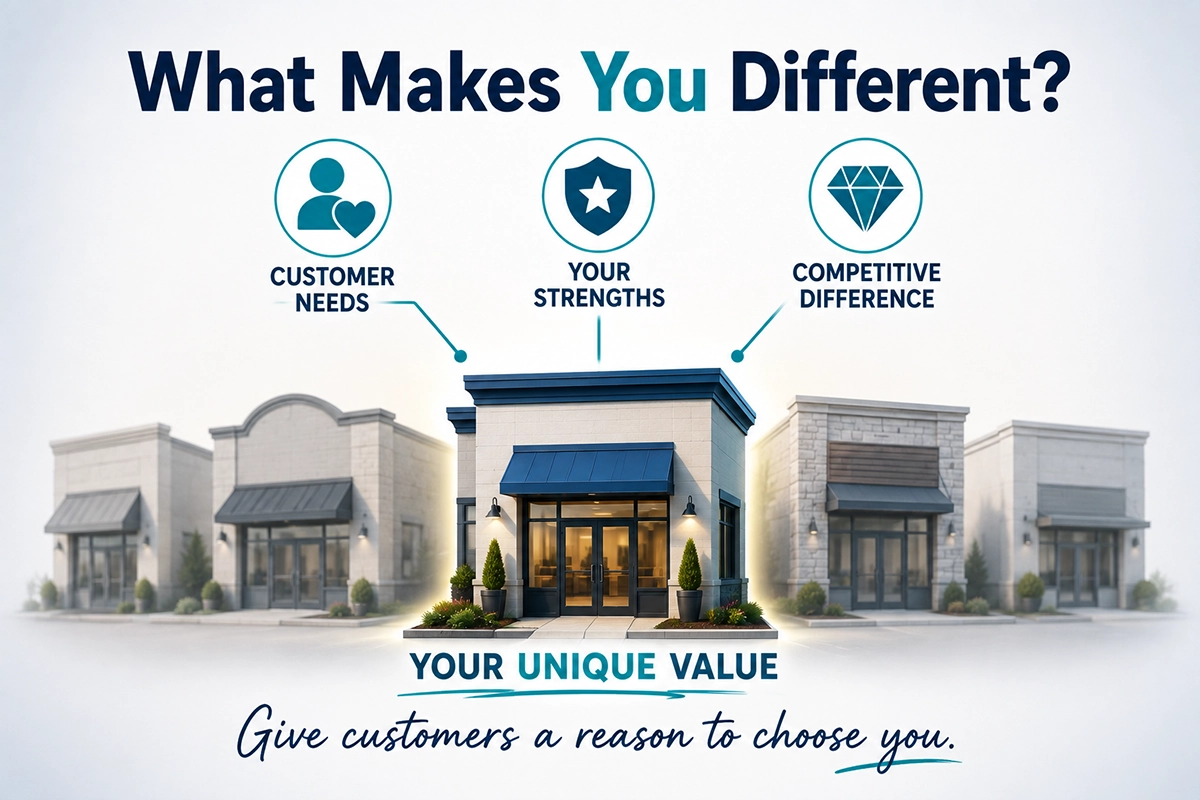
An effective value proposition usually sits at the intersection of three building blocks:
What your customers value
What your business does exceptionally well
What competitors don’t offer—or don’t communicate effectively
That intersection is your competitive advantage and the source of your unique value.
Suppose customers in your industry frequently complain that contractors don’t return calls or provide project updates.
Your company has developed a communication system that keeps customers informed throughout every project.
Competitors primarily promote price and workmanship.
Communication may now be more than a company strength. It addresses a customer problem, creates strategic value, and provides a meaningful point of differentiation.
That’s the foundation of a compelling UVP.
How to Write a Compelling Value Proposition
Once you’ve identified the right customer benefit and differentiator, put it into words.
A useful formula is:
We help [TARGET CUSTOMER] achieve [DESIRED RESULT] through [PRODUCT, SERVICE OR APPROACH], unlike [ALTERNATIVE], because [KEY DIFFERENTIATOR].
This isn’t necessarily the sentence you’ll place on your website. It’s a tool for identifying the key elements of your proposition.
A clear statement should be:
- Specific
- Relevant
- Believable
- Customer focused
- Easy to understand
- Meaningfully different
Don’t try to appeal to the whole world. A value proposition becomes stronger when it’s written with the right customer in mind.
And don’t add more detail simply to make the statement sound sophisticated.
Clarity is more powerful.
What Makes a Strong USP?
A strong USP isn’t necessarily clever.
It is specific.
Compare:
“We provide the highest quality service.”
with:
“Every customer receives a dedicated project manager and weekly project updates from start to finish.”
The first is a claim.
The second tells customers exactly what they can expect.
A solid USP can also be reinforced with evidence:
- Testimonials
- Reviews
- Case studies
- Guarantees
- Credentials
- Results
- Years of specialized experience
- Specific service standards
Your sales reps shouldn’t have to convince customers that vague claims are true. Your marketing and customer experiences should provide proof.
Test Your Value Proposition
Most value propositions shouldn’t be finalized in a conference room without input from actual customers.
Test yours.
Talk with current customers, your sales team, customer service staff, employees, and trusted business partners.
Ask customers:
Why did you initially choose us?
What do you value most about working with us?
What problem do we solve particularly well?
Why would you recommend us to someone else?
These conversations can uncover valuable information.
A business owner may believe price attracts new customers while research reveals that reliability is actually the greatest source of customer interest.
Your sales reps may repeatedly hear a customer need that your marketing team has never considered.
Those insights can help turn an ordinary proposition into a compelling one.
Avoid Common Value Proposition Mistakes
Most value propositions become weaker when businesses try to say too much—or nothing specific at all.
Some common mistakes include:
- Trying to appeal to everyone
- Focusing entirely on the company
- Listing features without explaining benefits
- Making claims competitors can also make
- Using industry jargon
- Promising something the business can’t consistently deliver
- Confusing a slogan with a value proposition
- Trying to include every product or service
- Failing to support claims with evidence
Another mistake is assuming your UVP needs to describe everything your company does.
It doesn’t.
The purpose is to communicate the most important reason the right customer should consider your business.
Put Your UVP to Work
Once you’ve created a compelling value proposition, don’t let it sit unused in a strategy document.
It should influence your:
- Website
- Homepage headline
- Advertising
- Social media
- Email marketing
- Brochures
- Proposals
- Videos
- Google Business Profile
- Sales materials
- Sales conversations
That doesn’t mean repeating the exact same sentence everywhere.
Your value proposition should provide the focus behind your messaging.
If exceptional communication is part of your unique selling proposition, for example, that promise should appear in your marketing—but it should also be apparent in the way your company answers calls, communicates with customers, and handles projects.
That’s how a marketing promise becomes a reputation.
Your Value Proposition Can Evolve
A successful value proposition isn’t necessarily permanent.
Businesses change. Customer needs change. Competitors change. Markets change.
Revisit your UVP when you:
- Add products or services
- Enter a new market
- Target different customers
- Change your business model
- Rebrand
- Face new competition
- Discover changing customer priorities
The goal isn’t to continually reinvent your business.
It’s to make sure your proposition continues to reflect the unique benefits customers receive from choosing you.
Give Customers a Reason to Choose You
Potential customers usually have choices.
Your marketing shouldn’t make them work to understand why your business deserves their attention.
Know your target audience.
Understand customer needs.
Study your competitors.
Identify what you genuinely do better or differently.
Translate specific features into specific benefits.
Then communicate that value clearly and consistently.
You don’t need to be the biggest company or offer the most services.
You need a strong value proposition that gives the right customer a compelling reason to choose you.
Discover What Makes Your Business Different with ELC Designs Group
Sometimes what makes a business valuable is obvious to its customers but surprisingly difficult for the company itself to put into words.
At ELC Designs Group, we help businesses identify their competitive advantages and transform them into clear, customer-focused marketing messages.
From brand positioning and website content to advertising, digital marketing, social media, and marketing materials, we can help make sure potential customers don’t just understand what you do.
They understand why they should choose you.
Book a Free Discovery Call to learn more